
 Blog •
16/09/26
I spent the 10th of September at CLO Summit 2026 in Munich, and the line that’s stayed with me since didn’t come from a feature demo. It came from the fit paradigm panel, almost as an aside: if 3D isn’t used across the whole product development workflow rather than dropped into one stage of it, it ends up creating more work, not less, and that’s exactly when it fails to get properly adopted.
That idea turned out to be the thread connecting almost everything I saw that day, from the new CLO3D construction features through to Bestseller’s Hypedrop model, a genuinely useful panel on sizing, and Lacoste’s approach to training an entire technical team on 3D. None of these work as isolated wins. They only work if 3D is treated as infrastructure that the rest of the process runs on, rather than a visualisation step tacked onto the end of pattern cutting.
Here’s what stood out to me, and why.
“If 3D isn’t used across the whole product development workflow, it ends up creating more work, not less, and that’s exactly when it fails to get properly adopted.”
Jade Oh and Sean Jeon covered a lot of ground on the product roadmap, and the direction is consistent: CLO-SET is being built out for simulation, digital asset management, fit maps, grading review, colour work across multiple styles at once, and technical checks like walking patterns, alongside a tech pack that’s finally starting to feel production-ready rather than a static export.
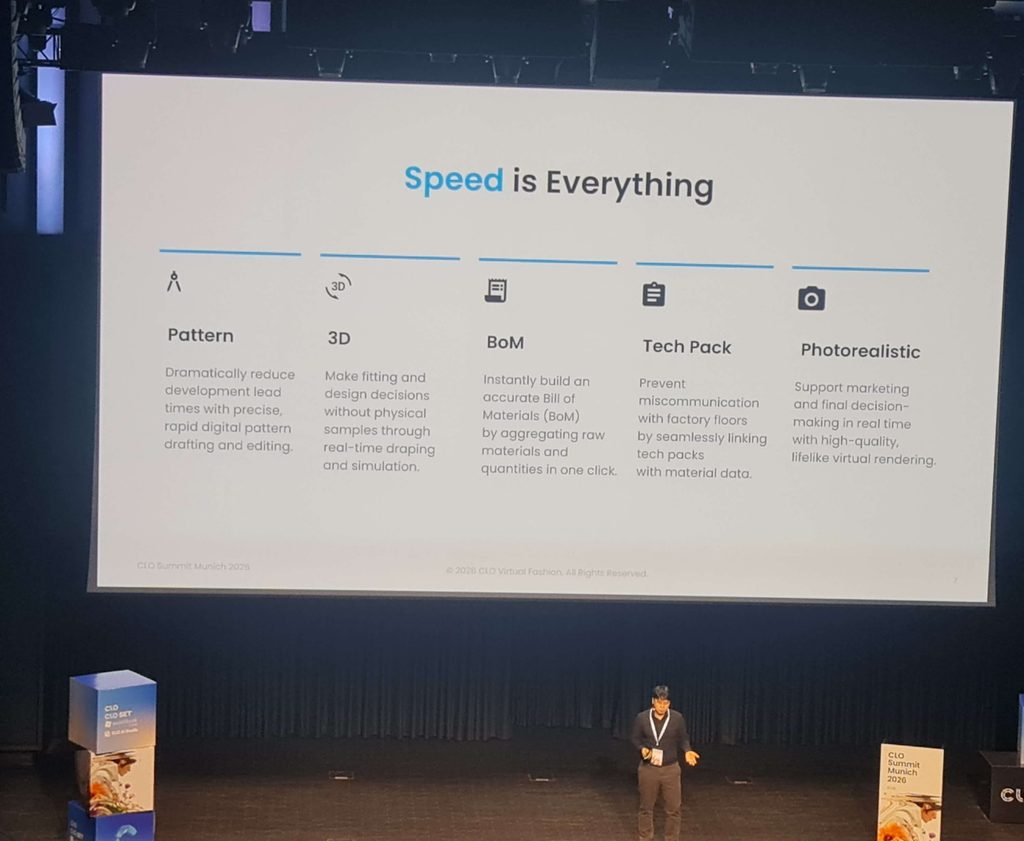
The tech pack improvements are the ones I think matter most for day-to-day work. Every brand and agency has its own tech pack standard, built up over years, and the ability to build your own pages and callouts inside CLO-SET means the output can actually match that standard rather than forcing a reformat every time. Sitting alongside this is CLO Trace, which is planned for release soon: it scans a garment using AI and builds a bill of materials from a library of similar items. I’d want to see it working on a real, complicated style before I trust the output, but the intent is right. This is the direction CLO-SET is heading in more generally: the 3D file stops being a nice picture and starts carrying embedded data, the actual construction and material information a garment needs to go into production.
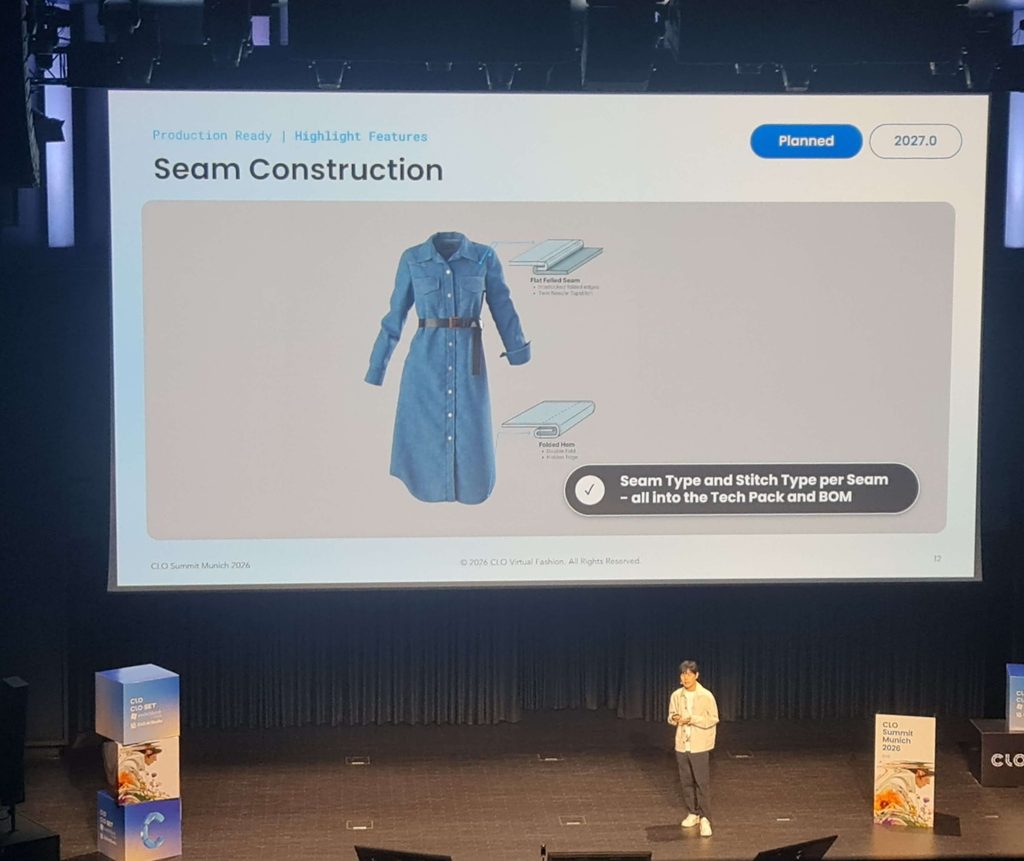
Construction detail is where the roadmap gets genuinely interesting. Seam type and stitch type per seam, feeding directly into the tech pack and BOM, is planned for CLO3D 2027.0 (it was shown clearly on stage as a roadmap item rather than something shipping imminently, so I’d treat the timing as indicative rather than fixed). Until now, getting a flat-felled seam or a twin-needle topstitch to read correctly in 3D has meant faking it with surface tricks. Having the seam and stitch type genuinely defined, and flowing through into production documents, turns that detail into usable data rather than a visual approximation.
Turnback for hems is arriving sooner, in CLO3D 2026.2, closing off exactly the same kind of workaround Sean Jeon referenced from the stage. A smart iron effect for pressed hems is coming in the same release, for finish quality rather than construction accuracy. Fit maps got a mention worth flagging too: elastic band fit map properties are also due in 2026.2, and the pressure map was called out as one of the most reliable fit maps currently available. For anything with elastane in the waistband or cuff, being able to model recovery properly, rather than treating elastic like any other woven or knit, is a real gap closed, particularly for activewear and loungewear development.
Then there’s hardware, which is the kind of detail that’s easy to skip in 3D because it’s fiddly, and easy to notice in a fit review when it’s missing. Functioning snap buttons and velcro are both due in 2026.2, along with mixed material graphics that support layering. None of these are headline features on their own, but together with leather goods edge painting and skiving, a new Pattern Studio and a faster GPU-based path tracer for rendering, all due in the same 2026.2 release, plus a fabric-level BOM editor and an expanded Knit Studio that already shipped in 2026.1, and zipper tape editing that’s already live, they add up to the same thing: CLO3D closing the gap between the 3D file and the physical, sellable garment, one unglamorous construction detail at a time.
The morning panel on Hypedrop was the session I keep coming back to. Hypedrop is Bestseller’s AI-driven wholesale platform, and the team on stage described cutting development time from two to three months down to six weeks, running a genuinely weekly workflow of ten to fifteen new designs, with no physical samples at any stage. The flow they described was AI for initial concept and design visualisation, 3D for the actual product approval that gates what goes into production, and AI again for marketing content and visuals. What’s been reported publicly since backs this up: Bestseller runs Hypedrop as weekly capsule drops open for a 72-hour ordering window, with production starting only against the quantities actually ordered.
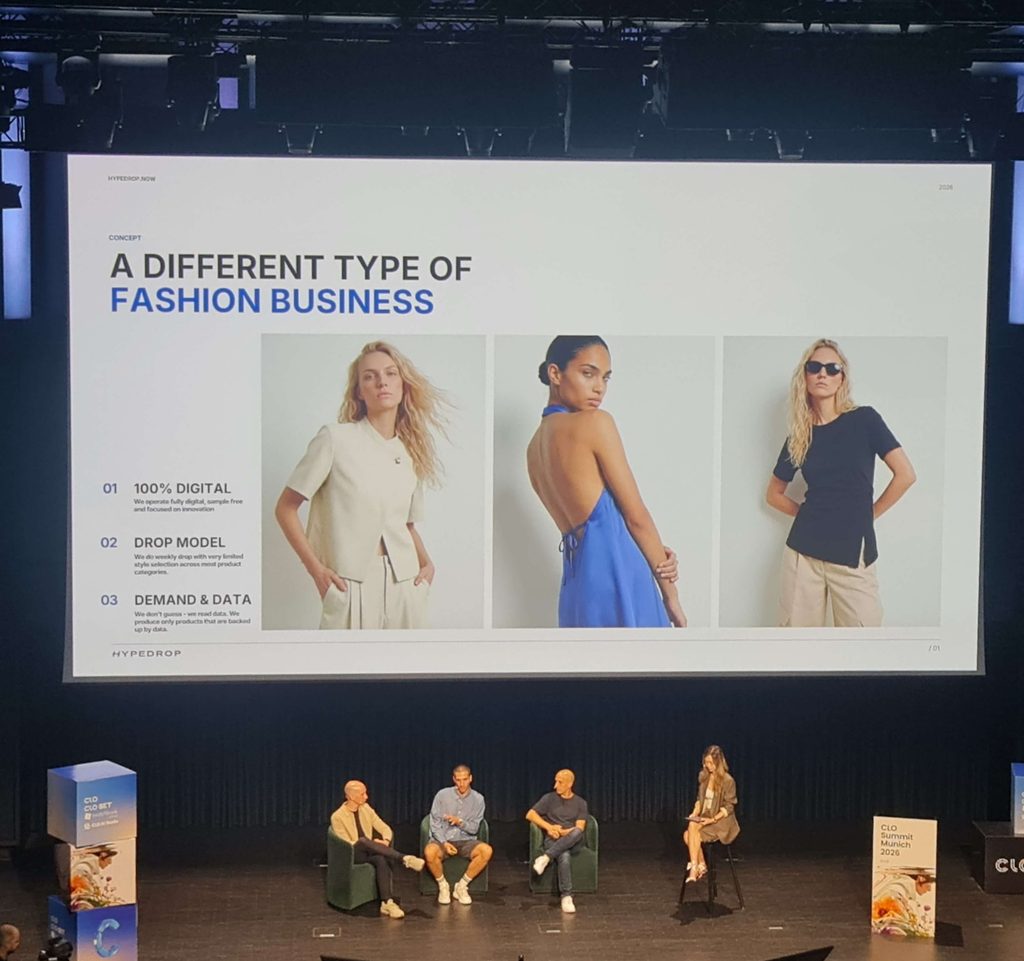
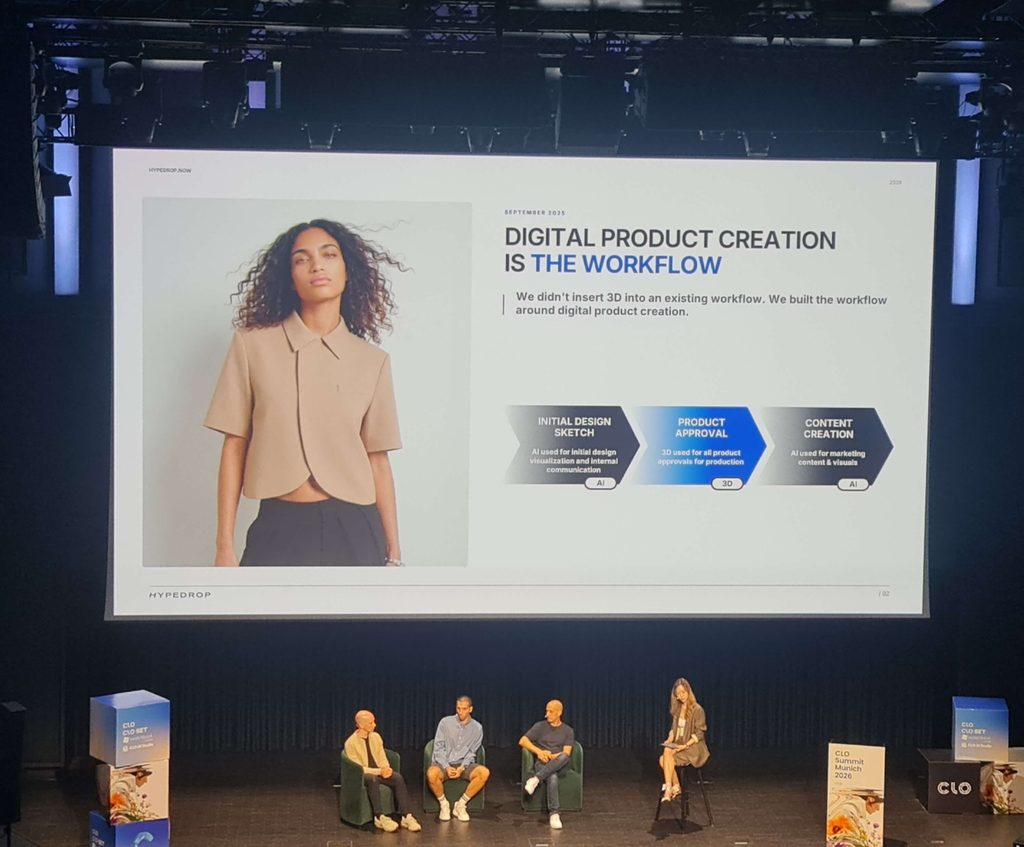
That last part is the bit I think matters most, and it’s why I’d argue this kind of model should be where more of the industry is heading, not just an interesting outlier. Producing against confirmed demand rather than a forecast is one of the biggest levers anyone has for reducing overproduction and unsold stock, and cutting physical samples out of the development cycle removes a genuinely wasteful step that most of us have simply accepted as normal. It’s also worth noticing where 3D sits in that flow: even in a heavily AI-driven process, 3D is still the checkpoint before anything becomes real. AI can generate a concept and AI can generate a marketing image, but the product approval that decides whether something actually gets made still runs through 3D. That’s a strong argument for what proper AI integration in fashion product development actually looks like, and it’s a case study I’ll be coming back to in more detail in a future post.
The caveat is that this works because it suits Bestseller’s portfolio: fast turnaround, broad size ranges, frequent drops. I wouldn’t expect the same model to translate directly to made-to-measure or heritage tailoring, where the value proposition is almost the opposite of speed. But for the volume end of the market, this is one of the clearest, most commercially credible examples I’ve seen of what “3D across the whole workflow” actually looks like when someone commits to it properly.
Even in a heavily AI-driven process, 3D is still the checkpoint before anything becomes real.
This panel was the one I found hardest to walk away from. The starting point was a 3D body scanning study run with the University of Bournemouth, which found that a large group of people who all measured as a UK size 12 had meaningfully different body shapes from one another. In other words, “size 12” doesn’t describe one consistent shape, it describes a cluster of quite different bodies that happen to share one or two measurements. The panel’s question followed naturally from that: should the industry be fitting to body shape rather than size number? CLO is actively researching this with ThruDark and the Bournemouth team, Penelope and Kyra, and a second question sat alongside it: is the block still a relevant starting point once fit changes so much by product type, fabrication and design detail?
This is territory I’ve spent a lot of time in over the past few months in my own writing, and seeing it backed by real body scan data was genuinely encouraging rather than just validating. Grading, as most of us learned it, assumes proportional scaling out from a base block, on the working assumption that a size 12 body is essentially a scaled version of a size 10 or size 14 body. The Bournemouth data is a direct challenge to that assumption, and it matches what most technical designers already know from fit sessions: two people in the same size can fit the same garment very differently, and it isn’t always just fit preference. My own view is that the block hasn’t lost its usefulness, but it needs to be allowed to flex more overtly by product category and fabrication than most current grading systems formally account for, and that 3D, with its ability to actually visualise shape variation rather than reduce it to numbers on a spec sheet, is one of the more promising tools we have for doing that properly. This isn’t solved yet, by CLO or anyone else, but it’s genuinely encouraging to see it being researched with real population data rather than assumed.
Size 12 doesn’t describe one consistent shape, it describes a cluster of quite different bodies that happen to share one or two measurements
Lacoste presented their journey of building 3D into their product development process end to end, through to retail, and spent real time on the part most software talks skip entirely: how they trained their technical team to actually use it.
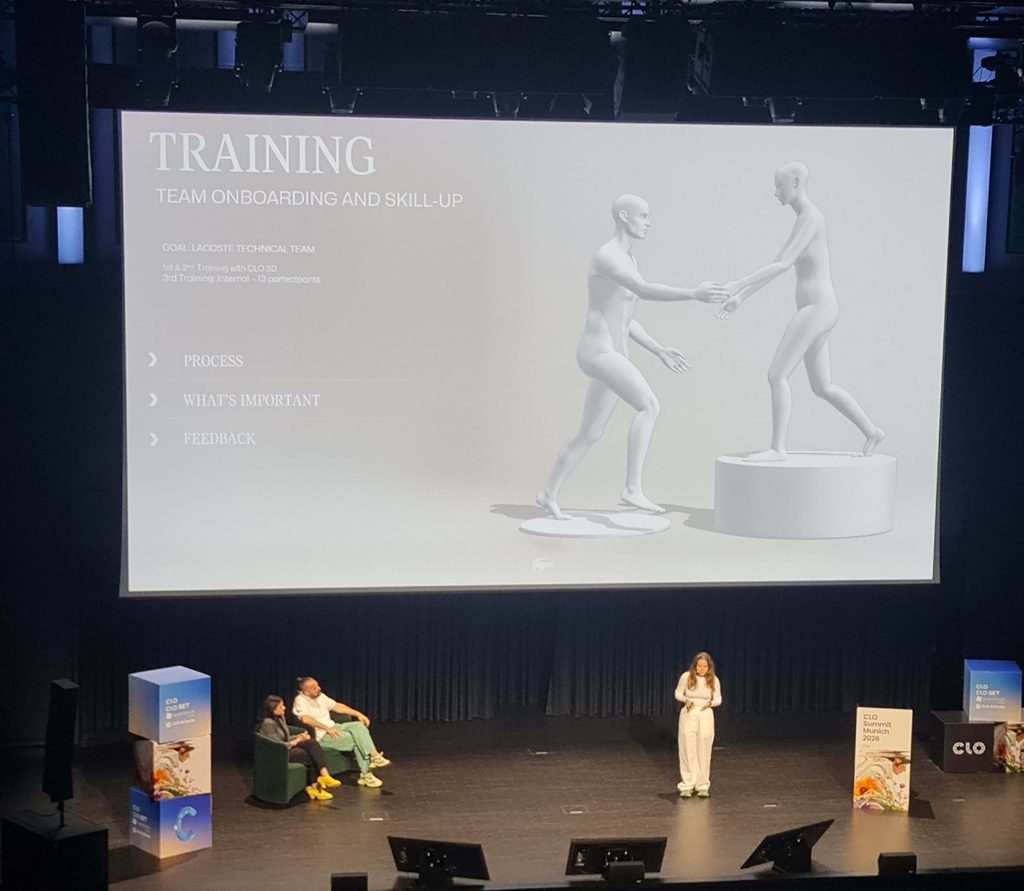
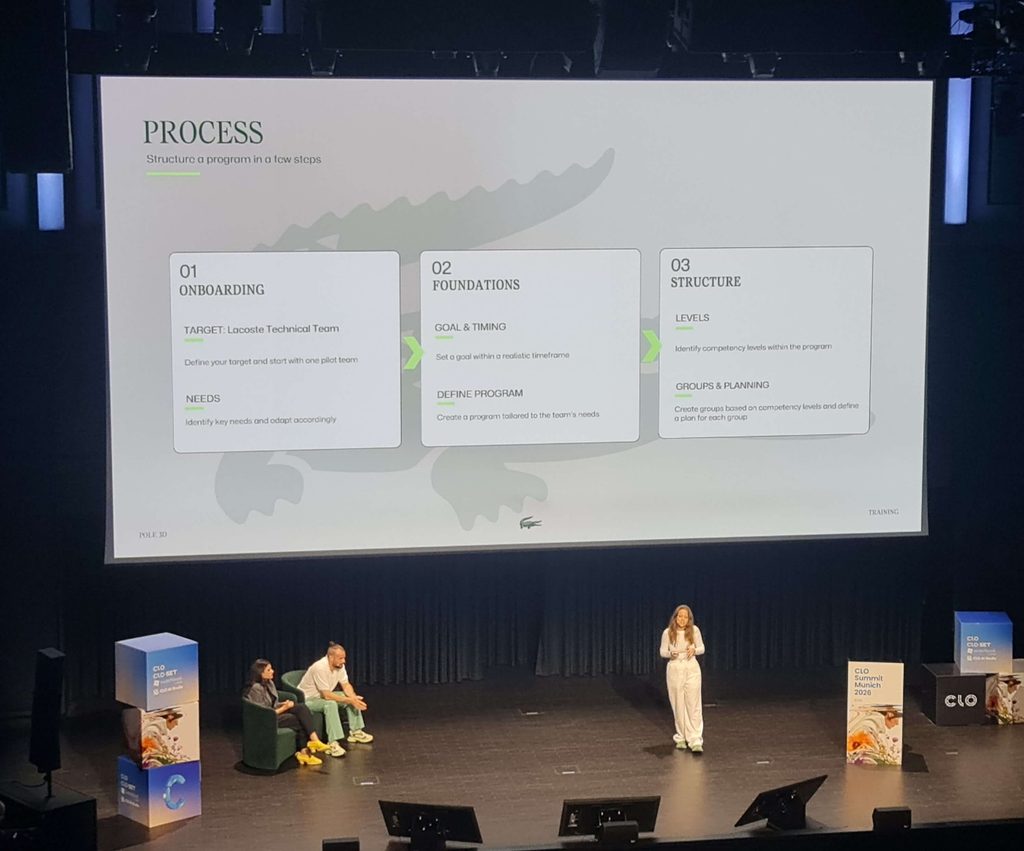
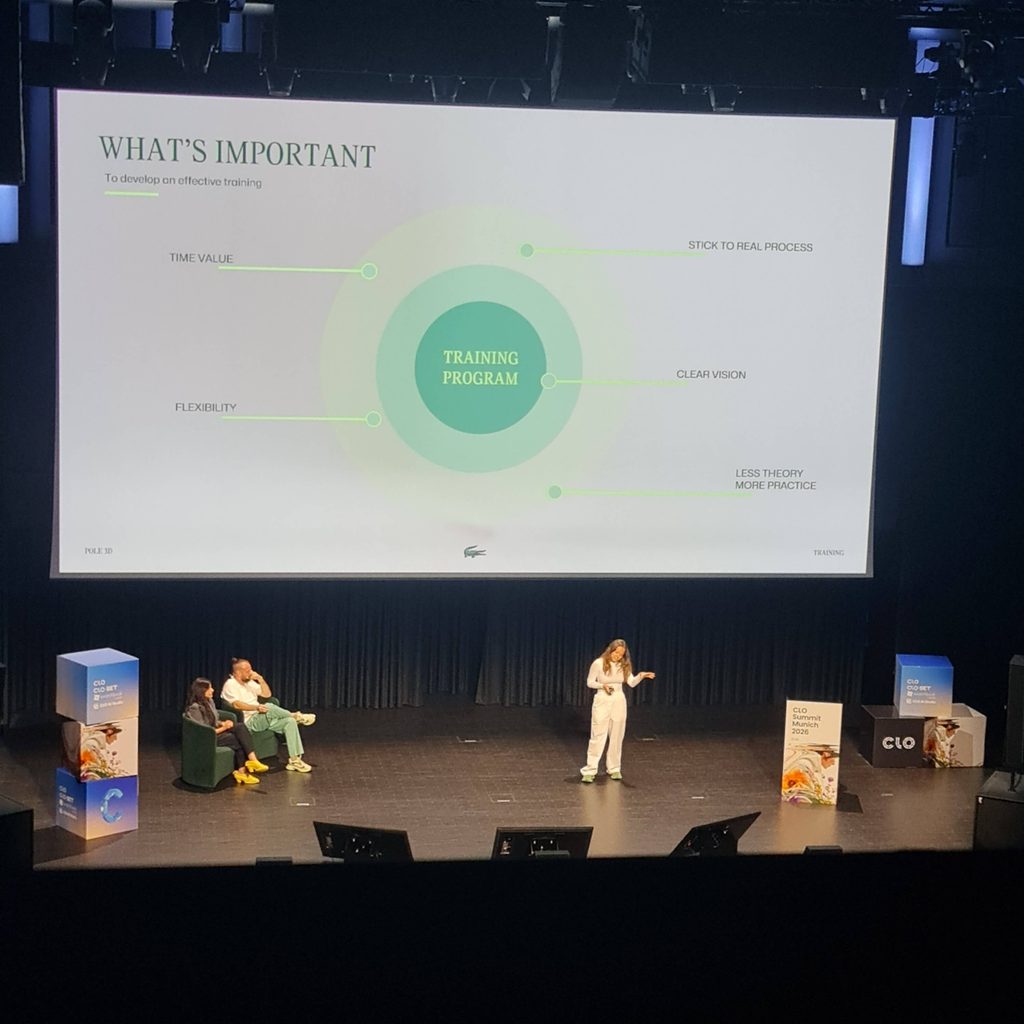
The programme was built in three stages. Onboarding meant defining a clear target group (Lacoste’s technical team specifically) rather than a vague company-wide rollout, identifying that team’s actual needs, and starting with one pilot team rather than everyone at once. Foundations meant setting a goal and a realistic timeframe, and building the programme around what that specific team needed rather than a generic course. Structure meant identifying competency levels within the group and creating separate groups and plans for each level, rather than teaching beginners and experienced users side by side. Running alongside all of that were five principles Lacoste treated as non-negotiable: time value, flexibility, a clear vision, sticking to the real process rather than a simplified training version of it, and less theory in favour of more practice. Two rounds of training were run directly with CLO3D, and a third was run internally, reaching thirteen participants.
What I liked about this was how honestly Lacoste presented the challenges alongside the results. Change of mindset, learning a genuinely new workflow and logic, having people at very different starting levels in the same programme, and the constant tension between sticking to the plan and sticking to a realistic timeline were all named directly rather than glossed over. But set against that were real, named benefits: better communication, people discovering new solutions they wouldn’t have found otherwise, and better cooperation between colleagues. That’s the return on a training programme that most software rollouts never bother measuring, and it’s exactly the kind of detail any brand should think through before assuming a 3D tool will embed itself.
That’s the return on a training programme that most software rollouts never bother measuring.
One of the quieter but more important updates came from s.Oliver, who talked about digitising their entire fabric library for properties and texture. The result they shared was a genuinely good one: they adjusted a pattern based on the digital fit, had a physical sample made, and it fitted perfectly first time, which meant they could reduce that development to a single sample round. Zaid Malkosh’s session on fabric digitisation covered similar ground from the supplier side, testing properties like stretch and recovery, with the longer-term potential to validate that against real wearer testing.
None of this is glamorous, and it’s easy to skip past in a round-up of new features. But it’s the actual foundation everything else in this post depends on. A seam construction feature, an elastic fit map, or an AI-generated bill of materials is only as good as the fabric data sitting behind it, and stories like s.Oliver’s one-sample result are the practical proof that this groundwork pays off.
Individually, none of what I’ve described here is a huge surprise. The industry has been circling AI-assisted concept work, better construction data, sizing research, structured training and fabric digitisation for a while now. What struck me at Munich was seeing how far the embedding has actually progressed in practice: not in a pilot, but at production scale, across a brand’s whole technical team, in the fabric data behind the scenes, and in the academic research questioning a fundamental assumption about how sizing works.
The software roadmap keeps closing genuine construction gaps, seams, hems, fasteners, one release at a time. The harder, more interesting question is the fit paradigm one, and it’s the one I’ll be watching most closely over the next year.
If you’re thinking about how to build 3D into your own team’s workflow properly, rather than bolting it onto the end of an existing process, that’s exactly the kind of structured rollout I work on through my CLO3D training and consultancy. Get in touch if you’d like to talk it through, or find me on LinkedIn if you were in Munich too. I’d like to hear what stood out for you.



 Go Back