 Blog •
01/10/24
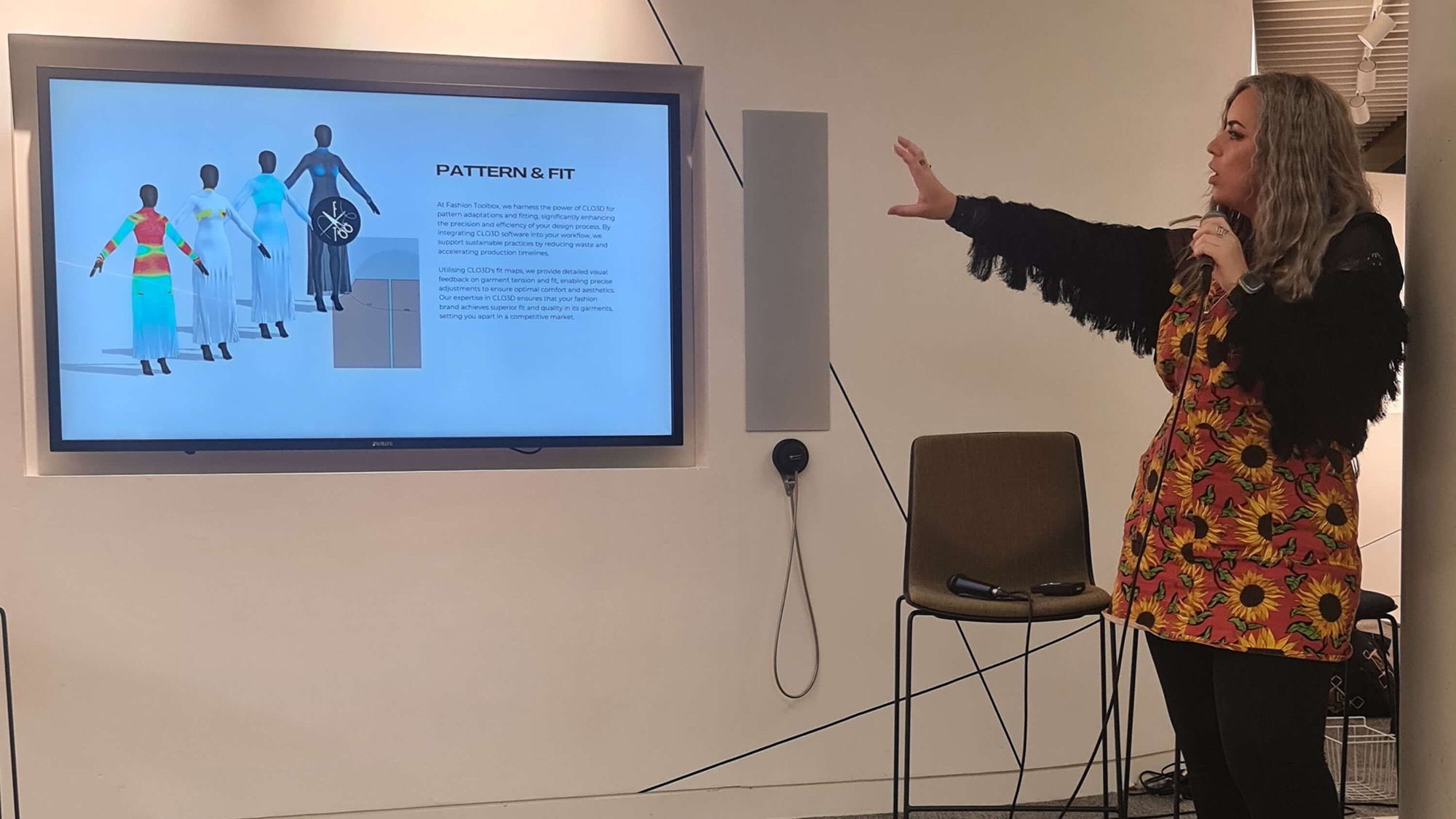
Earlier this year, I had the opportunity to speak at the Circular Fashion Event, hosted by AndReal. It was a brilliant local gathering that brought together businesses, designers, educators, and innovators to discuss what circularity really means for the future of fashion.
In a space focused on open dialogue and practical change, I was invited to share how 3D software, particularly CLO Virtual Fashion and Embodee, can support more sustainable practices throughout the product development process.
3D technology is sometimes discussed as though digitising part of the fashion workflow automatically makes it more sustainable. I think the relationship is more nuanced than that.
Tools such as CLO3D can help teams make more product decisions digitally, test alternatives before committing to physical development and reduce some unnecessary sampling. But circular design goes much further than the development process. It also asks us to think about material choices, durability, repairability, how long a product stays in use and what happens to its materials at the end of that use.
For me, the value of 3D is therefore not that it makes a garment circular. It is that it can give designers and product-development teams another opportunity to make better-informed decisions earlier.
During my talk, I explored how 3D tools can reduce over-sampling, support digital prototyping, and streamline the design-to-production workflow. By enabling teams to make informed decisions earlier, tools like CLO3D help minimise the need for unnecessary physical samples and avoid common errors in fit and construction.
It’s not just about adopting new software. It’s about using it intentionally to create space for testing, problem-solving, and better communication at every stage of the process.
See this in practice: In my Dorothy & Rose case study, I show how 3D product development was used to resolve fit, proportion and construction digitally, allowing the collection to move through development with just one physical sample.
Read the Dorothy & Rose 3D development case study
The panel discussion was a standout moment. Speakers included Suzy Shepherd, Natalia Willmott, Lauren Mason, and Sanduni Adikari, who brought forward honest, grounded insights into the challenges the industry is facing and the shifts that are urgently needed. It was encouraging to hear so many aligned perspectives from people working across different areas of the fashion ecosystem.
Several projects and businesses shared thoughtful, inspiring work that is already making a difference:
I was also impressed by the work of The Boot Repair Company, who are extending the life cycle of workwear, military, and sports footwear through repair. This kind of practical sustainability is what keeps products in circulation for longer and reduces unnecessary waste.
Want to explore the wider role of 3D in product development? I look in more detail at digital sampling, fit review, communication and workflow in Why 3D Fashion Design Tools Like CLO3D Are Changing the Industry.
Looking back at the conversation now, I still see real value in the role 3D can play, but I think it is important to be clear about what that role is.
Digital product development can help us question designs earlier, test alternatives and potentially avoid some unnecessary physical development. What it cannot do on its own is make a product circular.
Circularity depends on decisions about materials, construction, durability, repair, reuse, business models and what happens to a garment when its first useful life ends. Many of those decisions are made early in product development, which is where I think 3D can make a meaningful contribution.
The opportunity is not simply to replace a physical sample with a digital one. It is to use digital tools to make more considered product decisions before resources are committed.
A huge thank you to Andrea Benahmed Djilali (AndReal) for the invitation to be part of the event, and to Rachel Hatfield for hosting with professionalism and warmth throughout the day.
Events like this serve as a reminder that sustainability and innovation are not separate goals. With the right tools and collaboration, they support each other. I left feeling energised by the conversations and proud to contribute to a growing movement towards smarter, more responsible fashion.



 Go Back