 Blog •
06/07/24
As someone who works across both traditional and digital pattern making, I’m interested in where digital tools genuinely make a difference rather than assuming that a digital process is automatically faster.
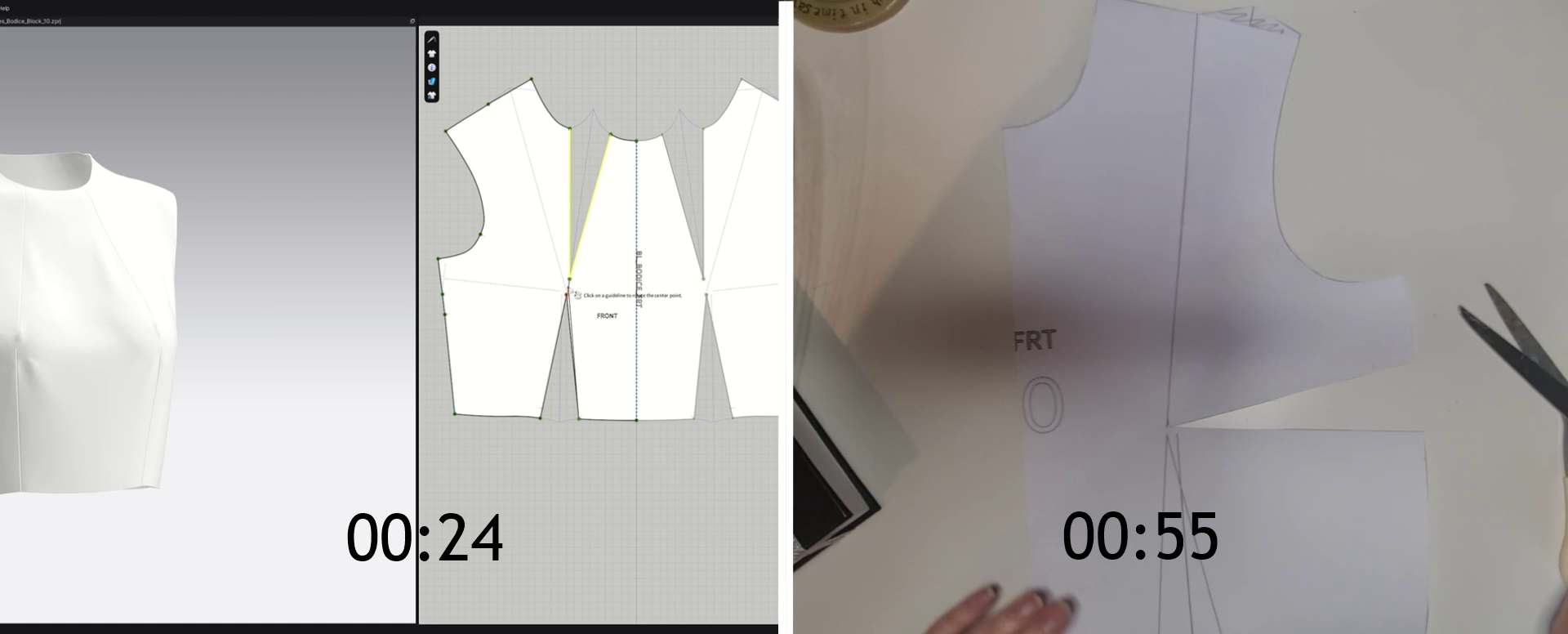
So I ran a simple time trial. Using the same basic bodice block, I compared repositioning a dart using a traditional pattern-manipulation method with making the equivalent adjustment digitally in CLO3D.
This was not a scientific study or a test of every possible dart-manipulation method. It was one practical comparison using a task I already understand well, with the aim of seeing where the digital workflow saved time and where technical judgement was still needed.
Using a basic bodice block as my starting point, I timed how long it took me to reposition the dart manually and then repeated the same type of adjustment in CLO3D.
In this test, the digital process took roughly half the time, even though I spent additional time refining the final dart position.
One of the biggest differences was being able to make the pattern adjustment and immediately simulate the garment again. Rather than waiting until a later stage to understand how the change affected the 3D shape, I could review the result as part of the same workflow.
New to working with darts in CLO3D? Start with my quick How to Create Darts in CLO3D tutorial, which shows how to add dart shaping directly to the pattern.
Here’s what stood out:
Working digitally did not remove the need for precision. I still spent time refining the dart position and checking that the adjustment made sense within the pattern.
CLO3D gave me an additional way to review the result by seeing the garment simulated immediately, but the software does not make the pattern decision for me. Pattern balance, fit, construction and the intended garment shape still need technical judgement.
What the digital workflow gave me was enough information to decide more quickly whether the change was worth taking forward into the next stage of development.
Want to try the digital method yourself? My How to Rotate Darts in CLO3D tutorial shows the practical steps for changing a dart position while retaining the shaping in the pattern.
This was only one pattern adjustment, so I would not use it to claim that every digital pattern-making process is automatically faster than its traditional equivalent.
What it did demonstrate was where CLO3D can remove some of the friction between changing a pattern and reviewing the result. I could make the adjustment, simulate it and decide whether I was happy with the direction without moving between separate pattern and sampling stages.
For me, that is where digital pattern development becomes particularly useful. It does not replace the pattern-cutting knowledge behind the decision. It gives me another way to apply that knowledge, test an idea and gather information earlier.



 Go Back